
Professional fellows program at Tulane building valuable global collaborations
The Celia Scott Weatherhead School of Public Health and Tropical Medicine builds a culture of innovation through the sharing of ideas. A recent international collaboration built through a U.S. Government award seems certain to continue that tradition.
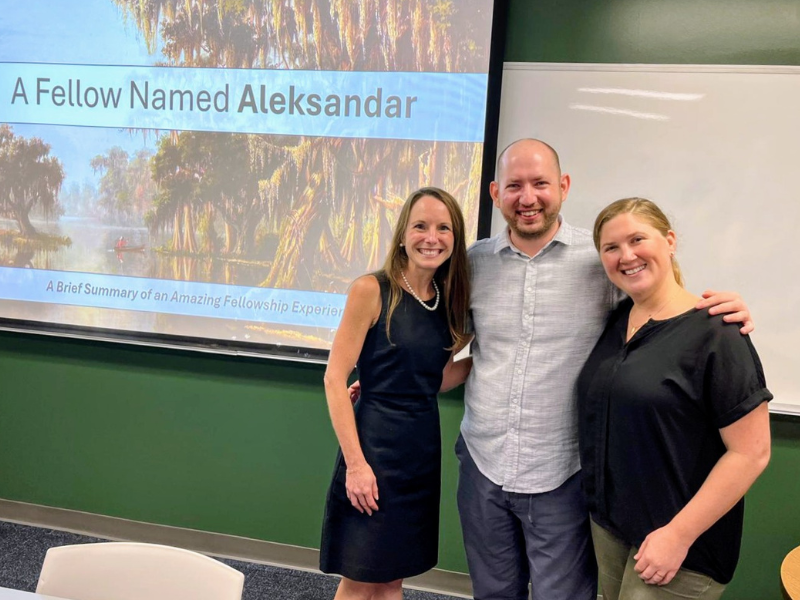
Last fall, Tulane was able to host Dr. Aleksandar Stevanović, a professional fellow from Serbia (Institute of Social Medicine, Faculty of Medicine, University of Belgrade), as part of the U.S. Department of State’s Professional Fellows Program (PFP), administered by the American Councils for International Education.
The Professional Fellows Program is a two-way international exchange designed to foster institutional partnerships between emerging leaders from Europe and Eurasia and counterparts in the United States working in similar spaces.
During his month-long fellowship at Tulane (with bookends in Washington D.C.), Stevanović engaged closely with the Mary Amelia Center for Women's Health Equity Research (MAC) under the supervision of Dr. Kelli Stidham Hall, co-director of MAC and WSPH associate dean of research. He contributed his public health background and research expertise while building meaningful professional relationships across campus and the broader New Orleans community.
“The experience was amazing,” Stevanović said. “Of course it's a professional fellowship, but it's also cultural. Exchange is one of the pillars. They really expect us to be involved, to get to know our host institution, but also the local community.”
Caitlin Moore, a senior program manager for MAC, and Stevanović submitted the exchange proposal that was selected for funding following a competitive review process: “From Families to Communities: U.S.–Serbia Academic Partnership to Advance Maternal Health and Family Well-Being.”
After identifying and securing the opportunity, Moore worked closely with Stevanović to co-design the goals and activities of the fellowship and hosted him during the visit.
“I saw that he was a medical doctor, specialized in social medicine with an interest in health policy, and a background in publishing, so I thought that this would all translate really well in our work,” Moore said. “I'm so thankful that he jumped right in and he was so eager to learn and contribute. He was a great blessing. I loved it.”
Several elements of each country’s work in health care were identified as converging areas, where lessons and practices learned in one community could be applied to the other. Shared challenges included resource distribution, combatting workforce burnout, community engagement, addressing health disparities among minority populations, and developing more home health care for women and families.
“We are sharing the same challenges, and since our healthcare systems obviously are very different, we are approaching the problems differently,” Stevanović said. “But this is exactly the value of an exchange. We get to learn from each other, from certain frameworks and solutions that we're trying to implement.”
Doulas and Postpartum Support
Both Moore and Stevanović pointed toward a specific example to illustrate the value of such collaborations: doulas. Louisiana and Serbia have similar challenges of delivering in-home care for new mothers, yet each place has different methods they employ to address those challenges.
"So, I was very interested in learning more about doulas, as this is a concept we didn't necessarily develop in Serbia," Stevanović said. "In my country, the practice involves trained home visiting nurses who provide preventive and supportive services for women who have given birth, but the thing is we have a deficit of health workers, nurses included. So, now there is a big question of how to do more with less and doulas are intriguing."
The project developed by Moore and Stevanović with support from Hall and the MAC team will necessitate continued collaboration in the form of a reciprocal exchange in Serbia. That is in keeping with the hallmark of the PFP: an emphasis on reciprocity and sustained collaboration that extends beyond the initial fellowship.
That reciprocated exchange is scheduled for July of this year and will take the form of a two-day hybrid symposium, which will bring together members of the Tulane community, New Orleans practitioners, and their Serbian counterparts to address maternal and child health emerging challenges, best practices, and cross-ocean similarities. Several members of the Tulane community -- including Moore, Dr. Melissa Goldin-Evans, and Dr. Rachael Lennon -- will attend in Serbia.
This next phase of the program will provide an environment for all parties to craft joint programming, exchange information, and build capacity.
“Serbia has a long history of in-home healthcare with mothers and families,” Moore said. “So we’ll be comparing and contrasting best practices between Louisiana and Serbia, and then we’ll disseminate our findings in a report after the conference.”
Above and beyond the original exchange, and Tulane’s participation in the symposium this summer, Tulane, along with the University of Belgrade, see the potential in a long-term research collaboration.
A lasting international partnership would continue to benefit both universities, and ultimately, the public at large. “This is the precise type of exciting global-to-local partnership building opportunity that Tulane is uniquely well positioned to foster and scale on a grander level,” said Hall. “The model of reciprocal exchange to share lessons learned and adopt promising solutions from a myriad of contexts to address refractive public health problems, like maternal mortality, has profound implications for innovation and impact on the communities and populations we serve.”
“I think that given the similarities between Louisiana and Serbia, it is very fruitful for a long-term partnership, both with our existing aligned research interests in maternal health and with other coexisting research interests we haven’t fully explored yet, such as tropical medicine,” Moore said.
The similarities, ultimately, are what will tie the communities together going forward. And while Stevanovic noted an initial surprise at how similar the cultures were – particularly in relation to how straightforward and open people were – he also expressed confidence in the program going forward.
Albeit with one unforeseen challenge.
“This was the nicest thing [about being in New Orleans]; there was no shock at all,” Stevanović said. “I really felt like I was at home … except for the humidity. This was the only part that reminded me that I'm not in Belgrade. It was very, very humid.”
The two-day symposium in July is open to members of the Tulane community. Those interested in attending virtually can RSVP at the link.