
Public Health for Profit?
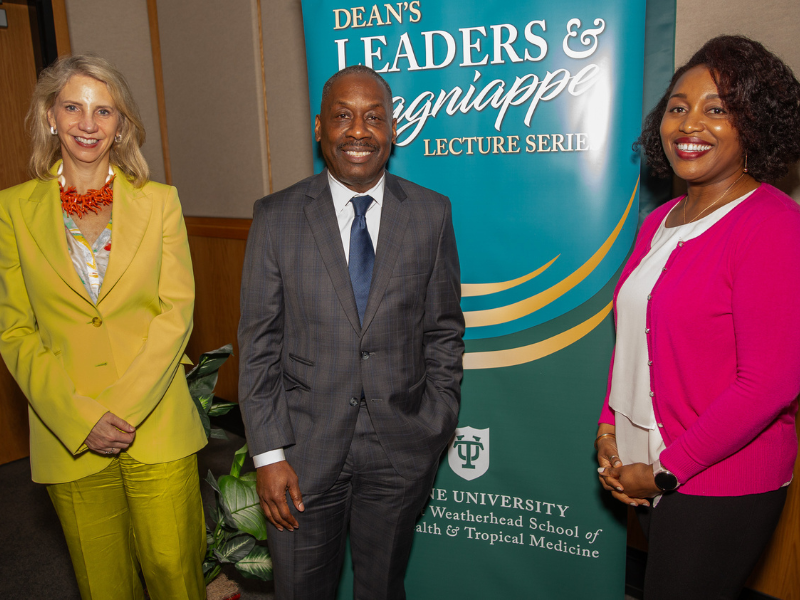
Dean Thomas LaVeist welcomed his latest guests recently as part of the Leaders & Lagniappe Lecture Series for a conversation on an unusual topic in public health: establishing a for-profit business.
Dr. Rebekah Gee and Dr. Adaeze Enekwechi brought extensive experience to the discussion.
Gee, an OB/Gyn, previously served as secretary of the Louisiana Department of Health under Gov. John Bel Edwards. After leaving public service, she founded Nest Health, which she describes as the first value-based health care provider designed to serve whole families.
In her opening remarks, Gee described the company’s mission to provide primary care to Medicaid patients in ways that meet families where they are—often literally. Care may take place in the home, but it could also happen in a Walmart parking lot or a coffee shop, wherever patients feel comfortable and care is easiest to access.
“Generational health begins at home,” she said.
Enekwechi, with a PhD in health services and economics, also has a background in government, having served as head of health programs at the White House Office of Management and Budget under President Barack Obama. A longtime health care executive, she later became president of IMPAQ, LLC, a research and implementation firm focused on health, workforce development, human services and international development. During her tenure, she led the firm through a merger with the American Institutes for Research.
While considering her next career move, Enekwechi was approached about working at a private equity firm. Initially, she assumed there must have been a mistake—she didn’t see herself fitting the typical private equity profile. Instead, the firm was seeking someone with her particular mix of policy, business, and health economics expertise.
The experience exposed her to the strategies investors use to build and scale companies—knowledge she later drew upon when becoming Chief Executive Officer of venture-backed care model, Cayaba Care, which has since been rebranded as Nadia Care.
Her company provides wraparound services for maternity care, including care coordination led by maternity navigators, member education, dietitian visits, lactation consulting, mental and emotional support, and doula services. The program spans 12 months but can be extended if the health plan chooses. Like Nest Health, Nadia Care focuses on Medicaid patients, with most visits occurring in the home, complementing and filling in the gaps between OB visits leading up to and after delivery.
“We address the issues that get missed,” she said.
Gee noted that the for-profit model can create space to test new approaches. Even during her time in government, she said, her policy ideas were sometimes seen as provocative.
“I would break things and then fix them,” she said.
As secretary, she implemented a “Netflix model” for hepatitis C treatment, creating a subscription-style payment system that lowered costs for Medicaid and incarcerated populations.
Enekwechi noted that while the care models used by Nest and Nadia may seem unusual in the United States, they align closely with maternity care approaches in many other countries, particularly in low- and middle-income settings.
“The notion that you would be alone during pregnancy is inconceivable,” she said, describing practices in Nigeria. “In almost every country on earth, you have supports.”
Both speakers credited their backgrounds in health care with helping them build successful startups.
“If you don’t understand the business of health care, it’s hard to succeed,” Enekwechi said. An MBA isn’t necessary, she added, but it is important to gain exposure to key business concepts.
Both companies operate on a value-based care model, receiving monthly Medicaid payments per patient and working to deliver strong outcomes within a defined financial margin.
Pointing to federal cuts over the past year, Gee suggested that public health may become increasingly privatized. Ultimately, she said, she would like to see health care redefined—not as a collection of individual services, but as a continuum that ensures people receive the support they need throughout their lives.