
Four ENHS Students Win Awards in Water Quality Research
Water is fundamental to human health. Safe and reliable water systems protect communities from exposure to numerous environmental hazards. And beyond basic needs, water quality directly influences public health outcomes, economic productivity, and community resilience, particularly in regions vulnerable to climate change, aging infrastructure, and environmental pollution.
The AW Lab (Environmental Health Microbiology and Water Quality Research Group) is led by Vice Chair & Associate Professor in Environmental Health Sciences Dr. Tiong Aw and has gained significant recognition in recent weeks.
Aw, a water quality scientist whose work focuses on the intersection of water quality, microbial exposure, and human health, will present at the upcoming Singapore International Water Week (SIWW) to be held in Singapore. This conference is one of the leading international forums focused on innovative water, coastal and flood solutions. Aw is organizing the workshop: “Re-thinking Water and Health: Integrating One Water and One Health,” and his participation in this international event will elevate Tulane University's Celia Scott Weatherhead School of Public Health and Tropical Medicine and ENHS’s visibility in the global water research community.
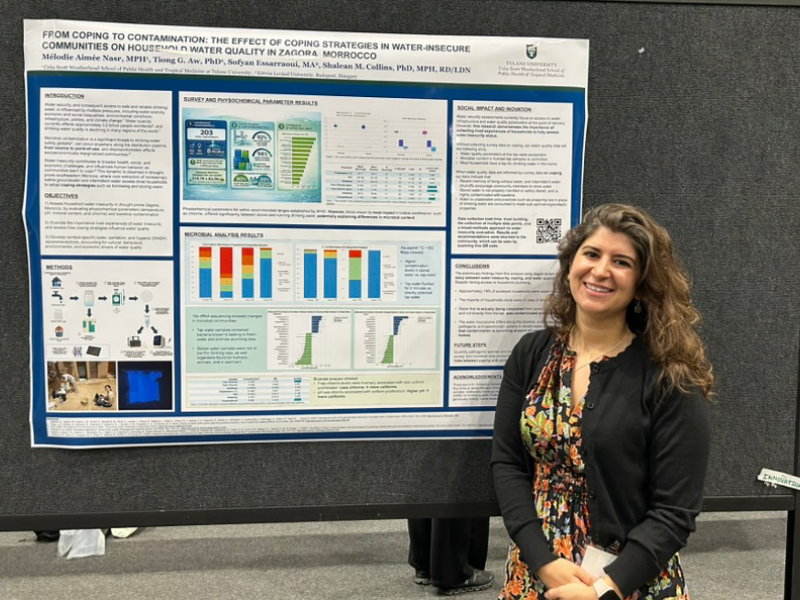
Mélodie Nasr, PhD candidate, 1st place in the Delta Omega Graduate Poster competition.
Poster title: From Coping to Contamination: The Effect of Coping Strategies in Water-Insecure Communities on Household Water Quality in Zagora, Morrocco
Water security, and consequent access to safe and reliable drinking water, is influenced by multiple pressures, including water scarcity, economic and social inequalities, environmental conditions, infrastructure, politics, and climate change. Mélodie’s research addresses household water insecurity issues in drought-prone Zagora, Morocco. Water security assessments currently focus on access to water infrastructure and water quality parameters at the point of delivery. However, Mélodie’s research demonstrated the importance of collecting lived experiences of households to fully assess water insecurity status.
Mélodie is nominated to submit an abstract for consideration in the National Delta Omega Student Poster Session at the American Public Health Association (APHA) Annual Meeting in November 2026.
In the annual Tulane Research, Innovation, and Creativity Summit (TRICS), ENHS students received all three of the school’s awards!

Keegan Brighton, PhD candidate, Dean of the WSPH Award for Excellence in Research and Presentation by a Doctoral Student
Poster title: Toilet to River to Tap—A Quantitative Microbial Risk Assessment of De Facto Wastewater Reuse Systems in Louisiana
Louisiana’s drinking water systems are highly influenced by surface waters that receive upstream wastewater discharges, creating conditions for varying degrees of unplanned water reuse across the region. The combination of extensive river networks, aging infrastructure, heavy precipitation, and flooding events, may increase the transport and persistence of enteric pathogens such as viruses in source waters used for drinking water production. Although conventional treatment substantially reduces microbial contamination, concerns remain regarding low-level exposure to viruses, particularly during extreme weather events or periods of elevated wastewater influence. Keegan’s research addresses the relationships among wastewater inputs, environmental persistence, treatment performance, and potential human health risks in Louisiana’s water systems.

Daniel DeMilia, MPH student, Dean of the WSPH Award for Excellence in Research and Presentation by a WSPH Master's Student
Poster title: Molecular Evaluation of Suspected Positives to Assess Specificity in a Detection Assay for Legionella pneumophila
Legionella pneumophila is the primary etiologic agent of Legionnaires’ disease, a potentially fatal form of pneumonia that disproportionately affects immunocompromised individuals. Transmission occurs through inhalation of aerosolized water droplets from contaminated building water systems. Legionella is the leading cause of reported waterborne disease outbreaks in the United States. Traditional methods for detecting Legionella in environmental samples are time-consuming. Daniel’s research evaluates new rapid assays for detecting Legionella in drinking water, with a plan to integrate new technology into an environmental surveillance of emerging pathogens.

Mia MacDonald, Cheryl Cole, Caroline Hampson, BSPH students, Dean of the WSPH Award for Excellence in Research and Presentation by a WSPH Bachelor's Student
Poster title: Backwash Olympics 2.0: Bacterial Growth in Reusable Water Bottles Among Undergraduate Students
Reusable water bottles are widely used among college students; however, cleaning practices and bottle design characteristics may influence bacterial accumulation. While many of these microorganisms are harmless environmental bacteria, poorly maintained bottles may also harbor opportunistic pathogens that could pose health risks, particularly to children, older adults, or immunocompromised individuals. These undergraduate students’ research increased our understanding of bacterial accumulation in reusable water bottles, which is important for developing evidence-based hygiene practices and reducing potential exposure to harmful microorganisms.